Showing posts with label installation. Show all posts

Thursday, 30 May 2013

Self-Directed Project: 'Tsukumogami'

For my first self-directed project in university, I wanted to try and explore a similar theme while exploring new methods to express my ideas. The result was this idea for an installation piece.


The idea dawned upon when I looked under the tables clustered together in my studio. How the extra unused lockers were all gathered together at such an irregular fashion drew an odd impression of a space one may try to crawl through. I considered the possibility of offering someone a view of being like a lost object.


At its most ambitious scale, I felt it would have been ideal if I were to somehow set up a space to use and build a maze-like structure for people to crawl into and under. Otherwise, I considered to settle with using a table to substitute as a simple roof. In any case, the low-lying walls are to be lined with lockers, being key to people in their function in storing items of importance. I spoke to other students about kinds of objects they had lost and considered the possibility of gathering a collection of such objects to scatter within the maze.


In the end, the latter idea was put to use as I was unable to find the place or time to get a large area for a low-lying maze structure, however simple its design may be. A table was used as a roof, with lockers in the centre and around the edges to give support and ensure the whole thing didn't fall in on itself.


I chose to name the piece Tsukumogami, after a part of Japanese folklore that spoke of inanimate objects that would manifest life of their own after a hundred years of no longer being used by their former human masters. This premise of the object and how it outlives the owner intrigued me and probably worked to draw a connection to a major inspiration for this project, Mike Nelson.
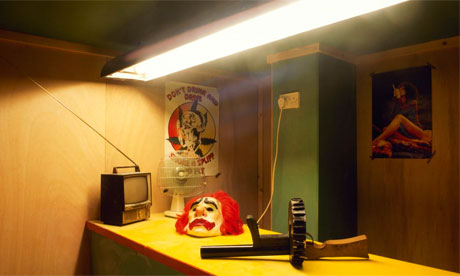
The Coral Reef (2000) by Mike Nelson

Nelson is an artist who produced a room-based installation piece entitled The Coral Reef (2000). This piece is to work as a representation of ideologies of minorities dwelling deep within the base of a capitalistic society. Here, they have 'calcified' among each other, even with those seeming to contradict, as if they have in turn become lost ideals. I found a hauntingly fascinating experience in entering The Coral Reef.

The Coral Reef (2000) by Mike Nelson

"To enter Mike Nelson's 'The Coral Reef' is to leave the physical fabric of the city and enter a parallel world. Rooms, doors, passageways, all bear traces of habitation and decay, making narrative promises that are never fulfilled. The visitor to 'The Coral Reef'' soon becomes disorientated, even lost, as they explore its depths."

Tsukumogami (2010)

In having attempted such a similar idea now, and now with hindsight, I have sometimes wondered whether there might be a factor of admiring and emulating being different issues. Although I can still certainly say that I greatly admire the work and idea behind Nelson's piece, I can't say I felt particularly satisfied with my means of exploring for this project. It may be that this was too much of a diversion from what I primarily wished to invest in exploring for my artwork. This certainly went on to feel more apparent later on in my time at university.

Interior of Tsukumogami (2010)

Wednesday, 22 May 2013

'The Weight of History'

For my second university project brief, one of the tutors assigned each student a book from the library at random. We were to take out our chosen texts and select something to base our art piece on. All the students' outcomes were to be collectively exhibited around the walls of the studio in order of their date of origin, from which the title comes into play. However, since I never actively recorded any of this in terms of photography, what I can discuss is the subject I had been assigned, what information I selected from it and how I expressed it.

The text I was assigned with for this project brief was entitled Art: A Sex Book by John Waters and Bruce Hainley.

The book is a compilation of various works from artists that range from startling to graphic depictions of the human body and activities to more abstract images that can imply eroticism or at least something that seems unnerving. Among the collection of these works is a conversation between Waters and Hainley where they discuss the nature behind contemporary art and its provoking language and relationship with people. For my sketchbook I chose to highlight certain quotes from the book that I felt I could connect to in terms of their ideas on the nature of modern (provocative) art.

Contemporary art is rarely about making normal bodies.
- John Waters

Many designers' inspiration is haute recycling from the garbage.
- Bruce Hainley
 
Good art always brings up destruction, anarchy. Rebelling against - over turning - the old forms, the established regimes, that's the history of art.
- Waters & Hainley
 
The art world is a secret world with a secret language... People learn the language if they're interested enough.
- Waters
 
You see, we're laughing when we talk about contemporary art but we're laughing with it. What you have to do is be delighted by the nerve of contemporary art. You don't have contempt before investigation and yet contempt is what 98% of people have for contemporary art.
- Waters
 
People complain about certain images: 'Oh, it's pornographic, not art' and yet... we love to see certain things repeated over and over... There's something sexy about all that looking, but there's also something a little disturbing about it, pornographic. Contemporary art deals powerfully with the strangeness of looking at anything at all.
- Hainley
 
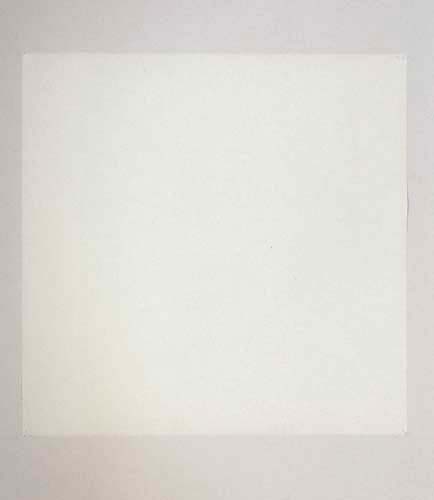
Among the shown pieces, one in particular I developed an interest in was a conceptual art piece by Tom Friedman, called 1000 Hours of Staring. This piece features a blank piece of paper which Friedman supposedly looked at for one thousand hours. Much like other conceptual works of Friedman's, this is about developing intrigue in a basic object by providing an unusual circumstance to its being.
 
1000 Hours of Staring (1992-1997) by Tom Friedman
 
Contemporary art requires some amount of trust. Did Tom Friedman really stare at a piece of paper for a thousand hours?
- Hainley
 
...That's one of my favourite pieces... What did he have on when he was staring? Was he nude? What was he thinking? If he has stared for a thousand hours he had to do some fantasising... There's confidence in paying for the result of his staring - it requires belief in what you're doing... Imaging him staring for all those hours: you're having a fantasy about his fantasy.
- Waters

Sketch of setup for projection response to 1000 Hours of Staring
 
What I aimed to produce in response to Friedman's 1000 Hours of Staring was a projection/audio installation piece. Contemplating on the possible occurrences throughout the 1000 hours looking into a piece of paper, I recorded the background noise from within my own room, and kept it at an ambient level so I could subtly loop the audio (for practicality reasons). Although it was certainly an entertaining notion for me to work on a more conceptual piece compared to what I've normally explored, in hindsight, I didn't feel greatly engaged with the work as a whole.